
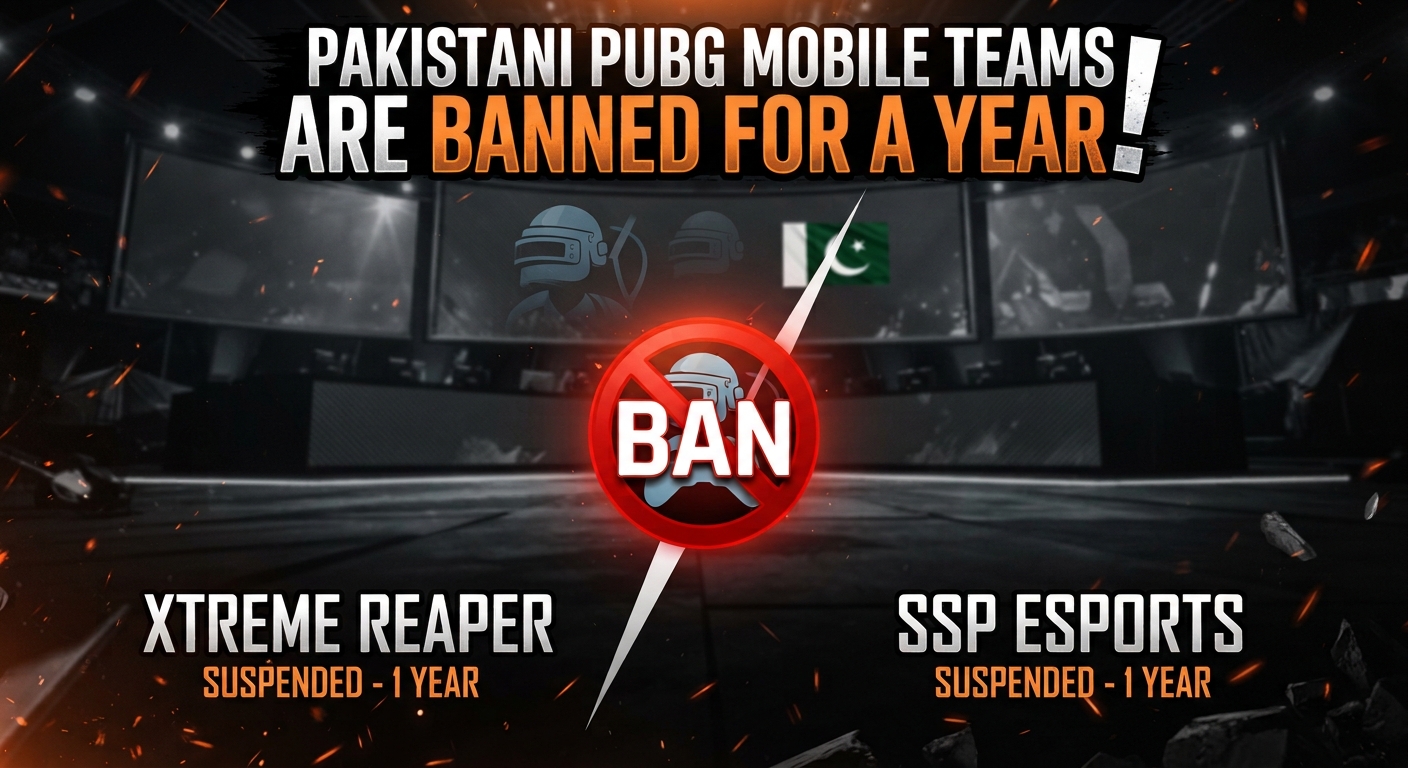
Pakistan’s PUBG Mobile esports scene has been rocked by controversy just weeks before the highly anticipated PUBG Mobile Global Open (PMGO) Season 2 lands in Lahore.
In a major competitive integrity crackdown, tournament officials issued one-year bans to multiple players and teams, dramatically altering the road to the Grand Finals. The decision has sparked heated debate across the community, with fans questioning the punishments while organizers insist the rules were applied fairly.
So what actually happened, who got banned, and which teams benefited from the sudden vacancies? Here’s everything you need to know.
Who Issued the Bans?
The sanctions were handed down by Level Infinite and the PUBG Mobile Tournament Administration, the bodies responsible for overseeing PUBG Mobile esports competitions.
Because the qualifying stages were played online, tournament officials relied on backend monitoring systems, account verification checks, device tracking, and competitive audits to ensure all participating teams followed official regulations.
When irregularities were discovered, swift action followed.
The Faisal Tanveer Case: A Clear-Cut Rule Violation
Among all the penalties issued, the case involving Faisal Tanveer is the most straightforward.
Tournament officials confirmed that Faisal received a one-year competitive ban after violating PUBG Mobile’s “Ringing” rule, one of the most serious offenses in organized esports.
What Is Ringing?
Ringing occurs when an unregistered player competes using another player’s account.
According to the ruling, Faisal was not officially registered to compete but participated by logging into the account of DMNxWOLF, a registered member of XTREME REAPERS, during tournament matches.
This violated Section 6.2 of the tournament regulations and triggered immediate disciplinary action.
The Consequences
The punishment affected more than just one individual:
- Faisal Tanveer received a one-year ban from official competitions.
- DMNxWOLF was also suspended for supplying account access.
- XTREME REAPERS were disqualified from the tournament and handed a one-year competitive suspension.
For tournament organizers, the message was simple: account sharing and identity misrepresentation will not be tolerated.
The SSP Esports Controversy: Why Fans Are Defending Rehman
While the XTREME REAPERS case is largely uncontested, the suspension of SSP Esports has become one of the most talked-about topics in Pakistan’s esports community.
At the center of the debate is star player Rehman, whose impressive performances throughout the competition earned him widespread praise.
The Community’s Perspective
Many fans believe Rehman was one of the strongest performers in the tournament and had legitimately proven himself against top competition.
Because the ban arrived shortly before the Grand Finals, some supporters argue that the punishment unfairly halted the momentum of a rising player who had earned his success through talent and hard work.
As a result, social media quickly filled with discussions, speculation, and criticism of the ruling.
What Did Tournament Officials Say?
According to the official decision, the issue was not skill or gameplay performance.
The violation centered on roster eligibility rules.
Officials determined that:
- Rehman and Murtaza “Joker” initially competed under Team Aminz during the qualifiers.
- After Team Aminz was eliminated, both players later appeared for SSP Esports during the same tournament cycle.
Under PUBG Mobile tournament regulations, players cannot switch rosters after competing for and being eliminated with another team during the same event.
Tournament administrators classified the move as an eligibility violation, leading to disciplinary action.
Why Was the Entire SSP Esports Lineup Penalized?
Fans wonder why players who were not directly involved still received the same punishment.
The answer lies in how professional esports regulations work.
Tournament organizers treat a roster as a single competitive unit. When ineligible players participate on behalf of a team, the responsibility extends to the entire lineup.
As a result, Brand, Softkiller, Hardkiller, and the rest of SSP Esports were penalized alongside the players responsible for the violation.
Whether fans agree with the punishment or not, tournament officials applied the rule uniformly.
Who Replaced the Banned Teams?
The disqualification of two high-profile teams created unexpected openings in the Grand Finals bracket.
To maintain a full competitive lobby, officials promoted the next eligible teams from the Qualifiers Final standings.
Hyper Esports Replaces SSP Esports
Hyper Esports officially advanced to the Grand Finals after SSP Esports was removed from the competition.
For Hyper Esports, it was an unexpected opportunity to compete on one of the biggest stages in Pakistani PUBG Mobile history.
Team End Goal Replaces XTREME REAPERS
Likewise, Team End Goal earned promotion to the Grand Finals following the disqualification of XTREME REAPERS.
What looked like a finished campaign suddenly turned into a shot at championship glory.
How Did Officials Catch the Banned Teams?
Many fans are asking: How do tournament admins catch violations in online qualifiers?
Simple. Players leave a digital trail, and tournament systems are built to detect suspicious activity.
1. Player IDs Don’t Lie
Every PUBG Mobile account has a unique UID. Even if a player changes their name, that ID stays the same. If the same player appears for different teams during the same tournament, it can be spotted quickly.
2. Device Checks
Tournament systems can detect when an account suddenly starts playing from a different device. Unusual device changes often trigger a closer review.
3. Network Tracking
Login records, locations, and connection patterns can help officials identify possible account-sharing or other irregular activity.
4. Community Watchdogs
Fans, analysts, and rival teams often review match footage. If something looks suspicious, they report it, giving admins another reason to investigate.
The Bottom Line
Online doesn’t mean invisible. Modern esports tournaments use account data, device checks, and match reviews to protect competitive integrity. These measures help officials uncover roster violations and account-sharing sooner rather than later.
Pakistani Stars Nominated for the Prestigious Esports Awards 2026
Why These Suspensions Matter?
The impact of these bans extends far beyond a single tournament.
With Lahore hosting the $500,000 PMGO Season 2, Pakistan is under the global esports spotlight. Tournament organizers aim to demonstrate that the region can uphold the highest standards of competitive integrity.
While opinions remain divided on whether the punishments were too harsh, one fact is undeniable:
In modern esports, talent alone is not enough. Teams must also follow every rule, every registration requirement, and every competitive guideline.
The latest suspensions are a powerful reminder that a single administrative mistake can end a season before the Grand Finals even begin.