Tag: LOL

  • Faker & Arslan Ash: What Defines the Ultimate Esports GOAT?

    Faker & Arslan Ash: What Defines the Ultimate Esports GOAT?

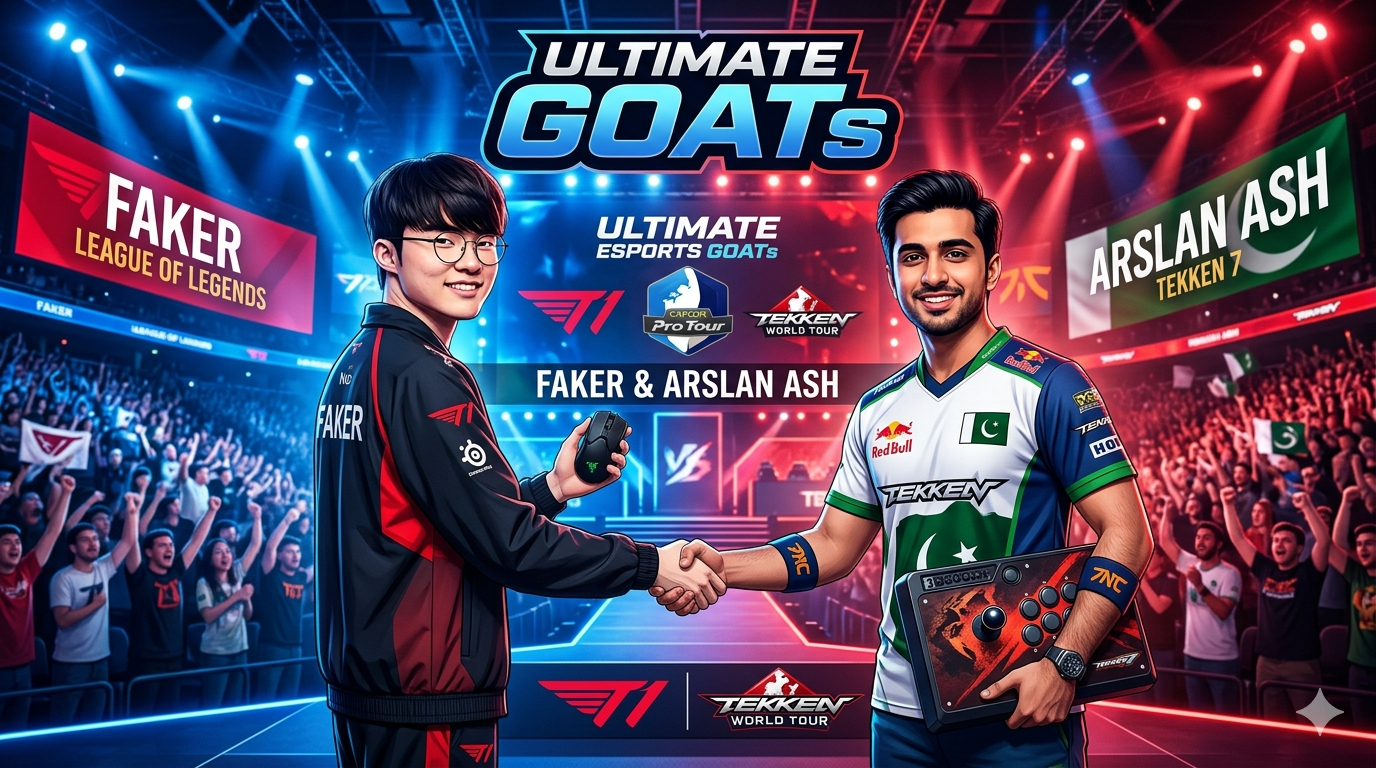
    Can we compare Faker, the famous “Unkillable Demon King” of League of Legends, with Arslan Ash, the king of Tekken? At first, they seem to have nothing in common because they play completely different games. Faker leads his legendary team, T1, on the Summoner’s Rift, while Arslan Ash fights alone in intense, split-second fighting game matches. Yet, these two esports legends share a very similar story of success. Both have stayed at the top of their games for years, won the biggest trophies like Worlds and Evo, and made their home countries proud. By looking at their amazing skills and strong mindsets, we can bring these two kings into a single frame and see what makes them the ultimate rulers of competitive gaming.

    Two Different Games, One Championship Mindset

    To understand how these two players became legends, we have to look at their separate kingdoms. Let’s start with the player who has been ruling the PC gaming world for over a decade: Faker

    The Rise of Faker: How T1’s Unkillable Demon King Dominated League of Legends

    The story of the “Unkillable Demon King” began in Seoul, South Korea. Before he was famous, a teenage Lee “Faker” Sang-hyeok started playing League of Legends at home under the secret online name “GoJeonPa”. He was so incredibly good that a massive professional team called SK Telecom T1 signed him in 2013 when he was only 16 years old.

    The moment he stepped onto the professional stage, his lightning-fast reflexes and genius moves shocked the world. Everyone knew a prodigy had arrived. Over his twelve-year career, Faker has grown into something much bigger than just a pro gamer. Today, he is a massive cultural hero for South Korea, standing proudly alongside K-Pop stars and famous movie actors as a symbol of Korean pride worldwide.

    Faker’s Unbreakable LoL Records That May Never Be Broken

    Faker competes on the Summoner’s Rift, the virtual map for League of Legends. It is a highly complex, 5v5 strategy game that is like playing high-speed chess with four teammates. In this difficult world, Faker’s achievements are unmatched:

    • Six-Time World Champion: Faker has led his team, T1, to a record-breaking six World Championships (in 2013, 2015, 2016, 2023, 2024, and 2025). No other player has ever come close to this level of dominance.
    • The Ultimate Stat Leader: He is the first player in history to score over 1,000 and then 2,000 tournament kills in the Korean professional league (LCK), while playing in more than 700 professional games.

    Changing the Business of Gaming Forever

    Faker did not just change how the game is played; he changed how the world looks at gaming as a real business. He is no longer just an employee—he is a part-owner of T1 Entertainment & Sports, holding a direct financial stake in a multimillion-dollar company backed by global giants such as Comcast.

    Every single time Faker plays a match, millions of fans log on at the exact same time to watch him live, breaking internet viewership records over and over. Because of him, major car brands and technology giants now spend millions of dollars sponsoring esports. He has proven to the world that gaming is a real, professional sport, training like an Olympic athlete at high-tech Red Bull Performance Centers across the globe.

    Faker’s Global Impact: The Ultimate Ambassador for Youth and Esports Culture

    Faker’s influence stretches far beyond the Rift. Named the official Game Ambassador for the Esports World Cup and Nations Cup through 2028, he stands alongside icons like Cristiano Ronaldo and Magnus Carlsen, giving esports players a global voice.

    At home, the Korean National Police Agency honored him as a Senior Officer, entrusting him to lead campaigns against youth cyber‑gambling. With the same discipline that made him a champion, Faker now guides the next generation toward healthier, brighter choices — proving that true greatness is measured not only in victories, but in the lives you inspire.
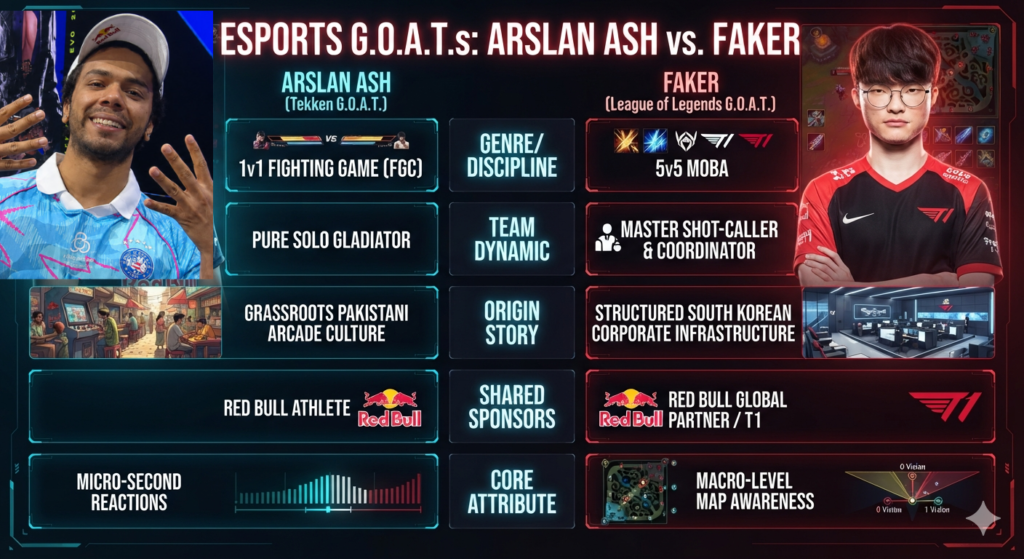
    Faker & Arslan Ash: Esports GOAT infographic comparing Tekken legend Arslan Ash and League of Legends star Faker. Side-by-side comparison displays metrics: Arslan Ash as a 1v1 Fighting Game Community (FGC) solo gladiator from Pakistani arcade culture with micro-second reactions, sponsored by Red Bull. Faker as a 5v5 MOBA master shot-caller for T1 from South Korean corporate infrastructure with macro map awareness, sponsored by Red Bull.

    Who is Arslan Ash? The Pakistani Prodigy Who Became the Tekken GOAT

    Just as Faker shapes the future from the Summoner’s Rift, Arslan Ash commands the same legendary respect from the fighting game grid. While Faker commands a five-man army, Arslan fights in complete isolation, where a single frame or a split-second miscalculation means the difference between a trophy and elimination.

    The History of a Solo Phenomenon

    Hailing from Lahore, Pakistan, Arslan Ash’s rise is a true grassroots story. Long before international sponsorships and streaming deals, his journey began at just eight years old in the dimly lit arcades of Lahore, mastering Tekken 4. Though initially set on a traditional path toward medicine, he chose to follow his passion for gaming — a decision met with skepticism at home. Arslan silenced doubts by dominating Pakistan’s local circuits, proving his skill was unmatched. In 2018, with modest financial help from friends, he traveled to Oman for his first international tournament. That leap of faith marked the turning point, launching him from local champion to a name recognized across the global fighting game community.

    Arslan Ash’s Unbreakable EVO Records: The Highest Ceiling in Fighting Games

    Arslan Ash has carved his legend in the unforgiving world of Tekken, a 1v1 fighting game where every frame and reaction can decide victory. His dominance is unmatched, reflected in a trophy cabinet that has redefined the fighting game scene.

    • The 8-Time EVO King: Arslan is an unprecedented eight-time Evolution Championship Series (EVO) champion. He shocked the world in 2019 by becoming the first unified champion to win both EVO Japan and EVO USA in the same calendar year.
    • The 2026 Milestone: Solidifying his legacy, Arslan captured his historic eighth EVO title in Las Vegas, routing a massive 1,355-player bracket to tie all-time fighting game records. He followed this up with an elite top-4 finish at the Esports World Cup (EWC) 2026 in Riyadh.

    The Arslan Ash Revolution: Turning South Asia Into a Global Esports Powerhouse

    Arslan Ash did not just win titles; he single-handedly put Pakistan on the international esports map. Before his 2019 breakout, the global fighting game community largely ignored South Asian talent. By defeating established international legends, Arslan forced global organizations to recognize Pakistan as a premier hub for fighting games. Today, representing the premium esports organization Twisted Minds and backed as a global Red Bull Athlete, he has opened the doors for a new generation of Pakistani pro-gamers to secure international visas, sponsorships, and careers.

    For anyone unfamiliar with Pakistan’s esports scene, one truth stands out: no Tekken player from the country can claim success without Arslan Ash paving the way first. He was the first drop of rain that broke through the drought of doubt, opening doors to respectful esports careers for Pakistani players. Before him, arcade gamers were often dismissed as loafers or wanderers — young men “wasting time” in unhealthy games with no future. Arslan shattered that mindset.

    By rising to the very top of global competition, he proved that discipline, resilience, and iron nerves could turn a passion into a profession. Unlike Faker, who never faced such cultural disdain in Korea, Arslan had to fight not only his opponents but also the stigma of his own society. His victories are more than trophies; they are proof that esports can be a path of pride and possibility for Pakistan.

    Fun Facts: What Makes Arslan & Faker Similar

    • One Continent, Two Legends: Both hail from Asia — Arslan from Pakistan and Faker from South Korea — proving the continent is home to esports greatness.
    • GOAT Status: Whether in Tekken or League of Legends, both are celebrated as the Greatest of All Time in their respective titles.
    • Age of Excellence: Each is 30 years old, yet still competing at the very top of their games.
    • Esports Icons: They’ve turned gaming into global careers, inspiring millions and reshaping how the world views competitive play.
  • 5 Reasons of LOL’s long and tremendous success

    5 Reasons of LOL’s long and tremendous success

    I first discovered League of Legends after watching the Chinese Drama Falling in Love with You, which was based on esports. The game featured in the competition looked strikingly similar to League of Legends, and that curiosity led me to explore and eventually find the real thing.

    I was astonished to discover that League of Legends is already 15 years old, first released in 2009, and yet it remains one of the most popular games today. What amazed me even more is that despite the rise of mobile gaming, this legendary title is still played mostly on PC, proving its enduring strength in the esports world.

    Then I grew curious and began gathering the reasons why anyone who experiences it once can never escape its spell and I got these five reasons:

    1. Game story is Compelling

    The game begins with two teams of five players, each controlling champions and aiming to destroy the opponent’s base. Victory goes to the team that succeeds first, making League of Legends a true strategy game built on teamwork. Yet many experienced players advise turning off your microphone, not to ignore your team, but to protect yourself from toxic language and avoid getting tilted during matches.

    In League of Legends, the path to victory runs through three lanes: top, mid, and bottom. Each lane is guarded by three turrets and an inhibitor, standing like watchtowers to block your advance. Break through them, and you’ll still face two mighty Nexus turrets protecting the enemy’s heart.

    But the lanes aren’t your only option. Slip into the jungle, and you’ll encounter powerful neutral monsters waiting to test your strength. The mighty Baron Nashor, the elemental Dragons (Infernal, Mountain, Ocean, Cloud, and the rare Elder Dragon), the Rift Herald, and the relentless Red Brambleback and Blue Sentinel all lurk there. Defeating them grants your team crucial buffs that can turn the tide of battle.

    Every choice, lane or jungle, is a strategic gamble, and that’s what makes LoL endlessly captivating.

    2. Environment, Ambiance, and Visual Appeal

    When you start playing League of Legends, what stands out most is the atmosphere. The map feels alive with bright colors and smooth animations that make every fight look exciting.

    For a casual player, the lanes look like natural paths leading the way, the jungle feels like a hidden shortcut full of surprises, and the towers shine like protectors guarding your base. At the center, the Nexus glows as the main goal, pulling your attention toward victory. It’s a vibrant world that feels welcoming and fun to explore.

    3. Wuxia style champions are super attractive

    I haven’t seen skins in any other game as appealing as those in League of Legends. Riot Games has done an impressive job with its roster of over 120 champions, each brought to life with unique skins that go beyond simple cosmetics. Many skins add new visual effects, animations, and even voice lines, making them feel fresh and exciting.

    Fans especially love collections like the K/DA skins (inspired by Riot’s virtual pop group), the Spirit Blossom series with its beautiful, fantasy‑style designs, and epic skins like Project Yasuo or Star Guardian Ahri. Corporate Mundo, with his hilarious businessman style, remains one of the most iconic skins Riot has ever created.

    These examples show how skins let players express their style while keeping the game visually engaging.

    4. spin-offs are Refreshing

    To keep the League of legends fresh, Riot Games has mastered the art of spin‑offs, giving fans experiences that go way beyond Summoner’s Rift. Its music videos, like the recently released Salvation, have earned huge recognition and continue the tradition of viral hits such as K/DA and True Damage.

    The animated series Arcane became a global phenomenon on Netflix, praised for its storytelling and visuals, and is often called one of the best video game adaptations ever. Riot has also published comics that dive deeper into champion lore and even created a board game that lets fans enjoy LoL’s strategy in a different format.

    5. Tournaments hit different

    League of Legends tournaments are organized in a tiered system that makes it easy to follow the journey from local play to the world stage. At the base are smaller amateur events where new players and semi-pro teams get a chance to prove themselves.

    Above that are the regional leagues, like Korea’s LCK, China’s LPL, Europe’s LEC, and North America’s LCS, which act like national championships where the best teams in each region battle for dominance.

    The winners then qualify for international tournaments, the biggest being the Mid-Season Invitational (MSI) and the World Championship (Worlds). MSI is a mid-year global clash, while Worlds is the ultimate showdown, often compared to the World Cup, where the strongest teams from every region compete for the title of best in the world.

    This structure makes LoL esports special because it builds a clear path for players: start small, rise through regional competition, and aim for global glory, all while showcasing unique playstyles from different parts of the world.

  • Top 5 Online Games Boys Love in 2025 – Fortnite, PUBG & More

    Top 5 Online Games Boys Love in 2025 – Fortnite, PUBG & More

    Did you know that nearly 53% of boys worldwide play online games? That’s over 2 billion players! From Fortnite and PUBG to Free Fire, Minecraft, and League of Legends, these games have taken the world by storm. With constantly shifting trends and rising engagement, the online gaming universe is expanding every day. Countless hours are spent learning, playing, and winning—and now, people of all ages, backgrounds, and regions are joining in. Most of this surge comes from developed countries where internet speed is unbelievably fast.

    Today, we’re spotlighting five of the most-played games globally—the ones kids just can’t quit, even when their parents scold them!

    online gaming image

    1۔ Fortnite

    · Daily active players: 60 million

    · Registered users: 650 million

    · Player demographics: 90% boys, 62% aged 18–24

    Why it’s famous:

    Launched in 2017, Fortnite shook the gaming world and hasn’t stopped since. Its biggest strength? It’s free—and playable on mobile, laptop, and PlayStation. The game starts with 100 players parachuting onto a storm-ridden island. You build your own fortress using bricks and stones, defend yourself, eliminate enemies, and try not to die. Players can choose from a variety of quirky outfits—one match you’re Spider-Man, the next you’re a dancing banana. Weekly updates, movie-themed characters, and immersive gameplay keep fans hooked. In May, the Star Wars version dropped, letting players live their Jedi dreams—and it was a massive hit.

    2۔ PUBG

    · Daily players: 25 million (plus 50 million in China)

    · Monthly players: 30 million (including China)

    · Registered users: 200 million (mobile only)

    Why it’s famous:

    Also launched in 2017, PUBG throws over 100 players onto an island for a survival showdown. The last one standing wins. While its gameplay resembles Fortnite, PUBG’s graphics are more realistic. Players say the best part isn’t winning “chicken dinner”—it’s making friends through teamwork. The detailed maps and technical features make it both thrilling and easy to play. Originally for PC, its mobile version broke records. Though its popularity dipped due to internet issues and bans in some countries, the 2025 updates by Krafton brought players back—and PUBG is rising again.

    3۔ Free Fire

    · Daily players (Feb 2024): 100 million

    · Monthly players: 54 million

    Why it’s famous:

    Free Fire is a battle royale shooter like Fortnite and PUBG, but it’s designed specifically for mobile users. It’s free, fast-paced, and features short matches. Celebrity collaborations boosted its fame—Cristiano Ronaldo’s “Chrono” character, BTS’s 2022 partnership, and appearances by Justin Bieber and DJ Alok all helped skyrocket its popularity.

    4۔ League of Legends

    · Daily players: 35 million

    · Monthly players: 53.3 million

    · Registered users: Over 180 million

    Why it’s famous:

    Released in 2009, this free PC-based battle game pits two teams of five against each other. Players control “champions” and fight to destroy the enemy base. Though it’s popular, it’s also criticized for its violent content. Revenue comes from selling skins and character upgrades. Despite being over 26 years old, it remains a fan favorite thanks to its mature content and competitive edge. Some players have quit due to performance issues and company policies, but millions still adore it.

    5۔ Minecraft

    · Daily players (2025): 50 million

    · Monthly active users: Over 200 million

    · Registered users: 300 million

    Why it’s famous:

    Unlike the other battle games, Minecraft is a peaceful sandbox experience. Players build their own worlds, protect their homes from “creepers” and “zombies,” and explore freely. It’s available on mobile, PlayStation, and more. Most players are kids aged 3–12, with 54% boys and 46% girls. Half prefer solo play, and 11% of parents play daily with their children. It’s also used for educational purposes—so it’s fun and informative!

    Honorable Mentions: Worth a Try!

    While the top five dominate the charts, a few other games deserve a shoutout for their impact and popularity among boys:

    • Roblox – A universe of mini-games created by users themselves. From obstacle courses to roleplay cities, it’s a playground for imagination and coding. Great for younger players who love variety and creativity.
    • Call of Duty: Mobile – Fast-paced shooting, realistic graphics, and intense multiplayer modes. It’s perfect for boys who crave action and strategy on the go.
    • Valorant – A tactical shooter that blends precision with superpowers. Though more popular among teens and older players, its competitive edge and team-based gameplay make it a rising favorite.

    Personal Take

    Gaming isn’t just a pastime—it’s a universe where every player has a story, a name, and a moment of triumph. I’ve spent more time understanding these games than playing them. Whether it’s Fortnite’s creative chaos or Minecraft’s quiet construction, each game offers something to learn. That’s why these titles aren’t just for boys—they’ve won hearts across all ages.

    So, which game is your favorite? Drop it in the comments below!

    Note: Stats may vary slightly, but this data has been compiled from multiple sources for accuracy.