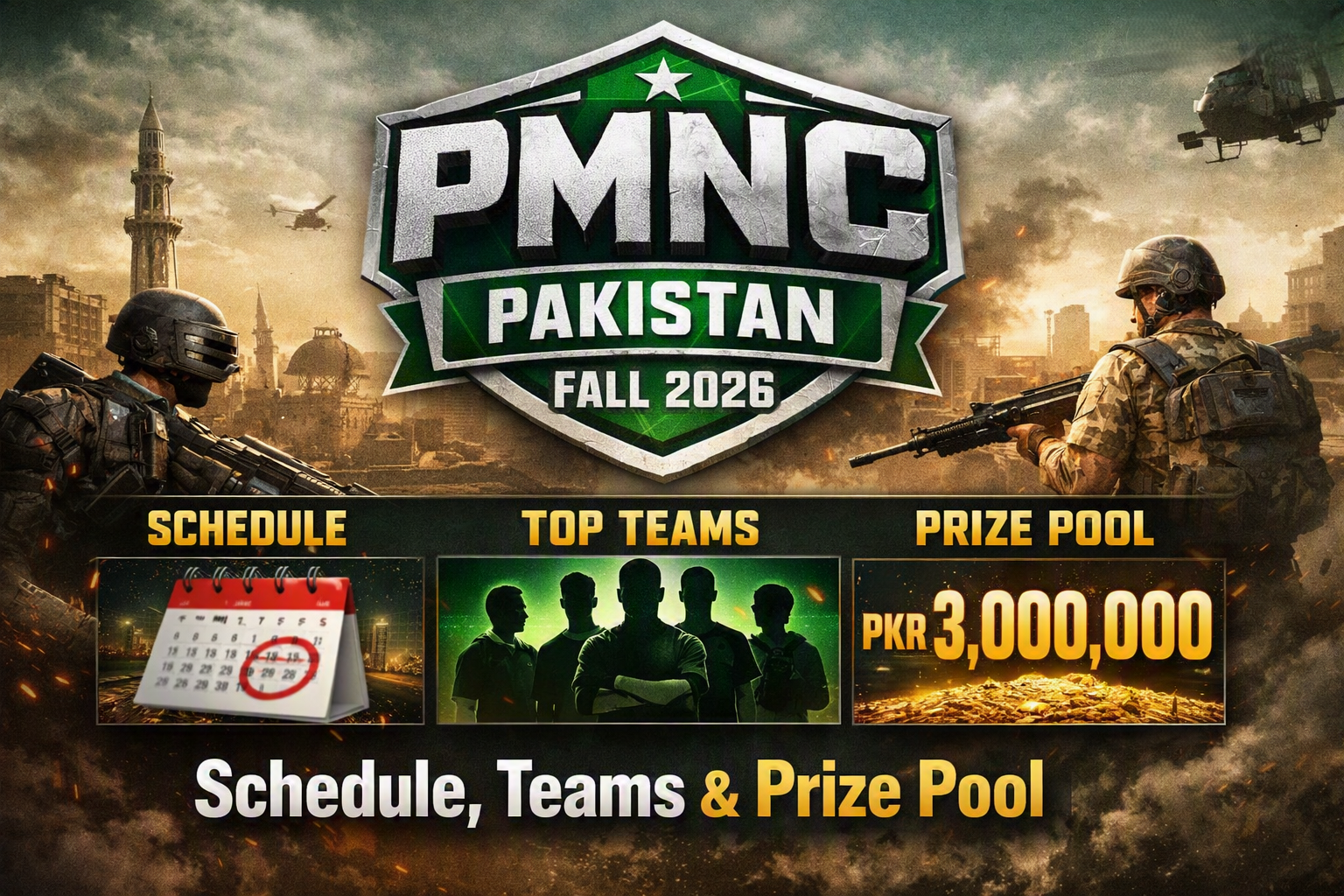
Lahore is about to witness history asKrafton and Level Infinite have launched a B‑Tier esports event in Pakistan, featuring a massive PKR 3,000,000 prize pool. The PUBG Mobile National Championship (PMNC) Pakistan Fall 2026 Grand Finals will ignite the Indoor Gymnasium at Nishtar Park Sports Complex on August 29–30, bringing together the nation’s fiercest esports warriors.
Pakistan’s Esports Rise
Once banned, PUBG Mobile has now become the heartbeat of Pakistan’s esports scene. With Tekken, PUBG, and other titles thriving, Pakistan is positioning itself as a future host for mega international events. The PMNC Fall 2026 Grand Finals prove that the country is ready to take center stage.
The Finalists of PMNC Pakistan Fall 2026
Sixteen elite teams have fought through grueling semi-finals to earn their place:
The qualification phase tested tactical consistency, split-second decision-making, and pure survival instinct:
Group A of the Semi-Finals kicked off on August 17, and it immediately turned into a survival test for the heavyweights from the central and northern qualifiers. Seventh Element absolutely stole the show, completely running the lobby to lock in the number one seed.
They aren’t heading to the Grand Finals alone, though. Teams like GCWXXZO Esports, Global Wiz, Loyalty First, Portal, The Mythicals, and True Esports all dug deep to punch their tickets. Shoutout to Maxebels too—they started the day looking a bit sluggish with zero momentum, but they clutched up when it mattered most to secure their spot.
Group B took over on August 18, bringing a chaotic mix of wildcard rosters and southern giants who immediately turned up the aggression. It was a total bloodbath, with teams like 313 Esports, Red Death Esports, X Generation, RTC Esports, Circle X Esports, 4 Vikings, and 7 Bandits trading blows all day just to stay alive in the qualification zone.
But the real drama came down to Faulty Devils. They had fans sweating until the very last second, pulling off a massive clutch on the final map to barely squeeze into that last qualifying spot for Lahore.
Prize Pool
The stakes are monumental, with a prize pool designed to reward excellence across all ranks:
Champion (1st Place): PKR 1,000,000
2nd Place: PKR 750,000
3rd Place: PKR 300,000
4th Place: PKR 175,000
5th Place: PKR 125,000
6th Place: PKR 100,000
7th Place: PKR 100,000
8th Place: PKR 75,000
9th Place: PKR 75,000
10th Place: PKR 50,000
11th–16th Place: PKR 25,000 each
Individual Glory
Finals MVP: PKR 60,000
Best Grenadier: PKR 40,000
This prize structure ensures every finalist is rewarded, while individual brilliance is celebrated with dedicated awards.
Partners & Sponsors
The championship is powered by strong partnerships:
Official Gaming Phone Partner: Infinix GT 50 Pro
Official Partners: Quick Topup, BigBaat
Special Partners: Government of Punjab, Sports Board Punjab
Venue
Location: Indoor Gymnasium, Nishtar Park Sports Complex, Lahore, Pakistan.
Honestly, it wasn’t upsetting about 4Thrives missing the trophy. What really stung was seeing them drop to 6th place and lose their 5th spot to Tianba. That’s what felt disheartening.
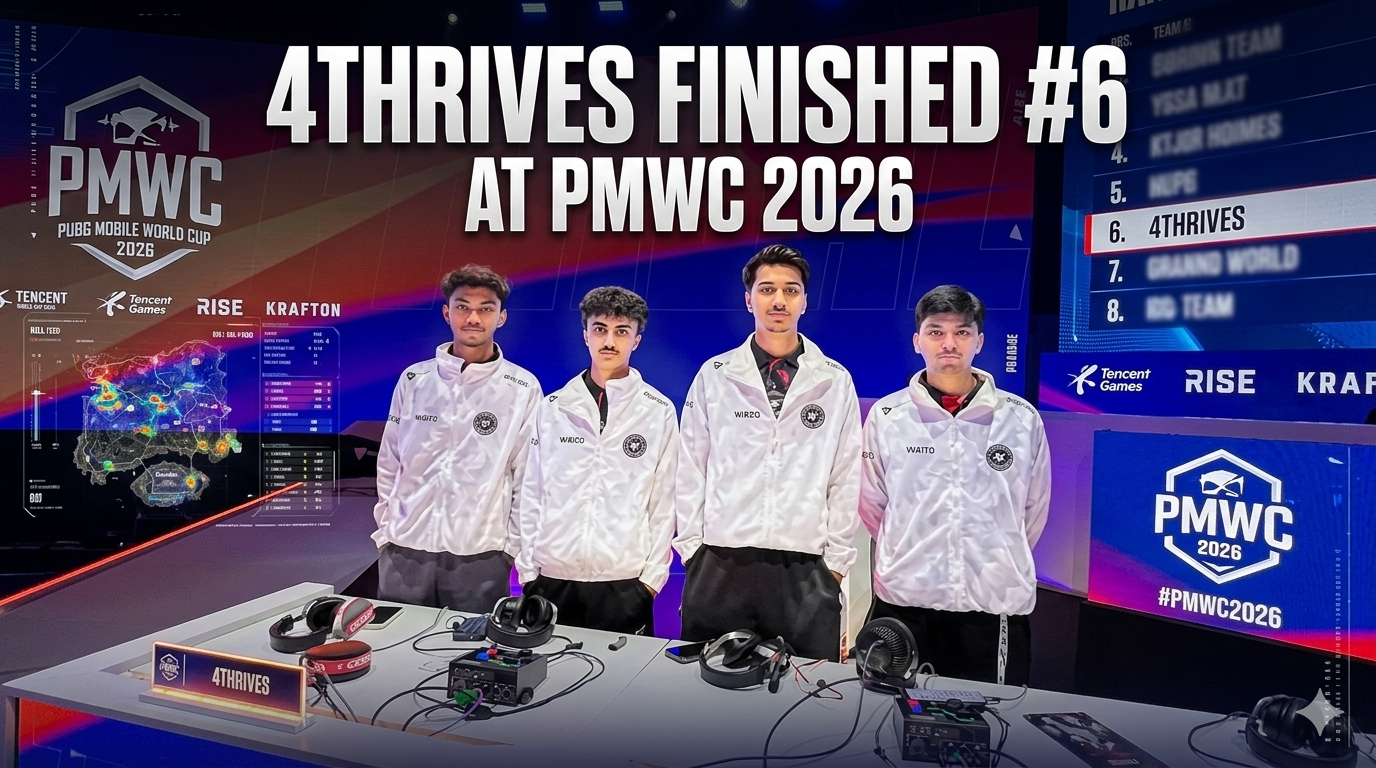
4Thrives absolutely dominated the group stage, going undefeated and securing a direct spot in the finals. While they surprised many by not earning a single WWCD in either the group stage or the finals, finishing #6 overall in the world is an outstanding achievement. This result is not just impressive; it’s a testament to their skill and determination, inspiring all competitors in the scene.
let’s break down group stage performance
In a tournament that analysts confidently dubbed the PMWC 2026 “Group of Death,” Pakistan’s 4Thrives Esports showcased their prowess by decisively claiming the top spot in Group A with an impressive total of 107 points. Their outstanding performance defied conventional PUBG Mobile strategies, as they surged directly into the Grand Finals without a single Winner Winner Chicken Dinner (WWCD). Instead, 4Thrives unleashed their firepower, amassing an incredible 80 points from eliminations alone.
Under the bold leadership of team captain IQ, whose fearless edge-of-zone rotations were crucial, the squad racked up 46 points on Erangel, 40 on Miramar, and 21 on Rondo. The standout of this aggressive display was Falak, who rightfully earned the Group A MVP title with 25 individual kills, a jaw-dropping 5,413 total damage, and 20 knocks. This remarkable performance solidified 4Thrives’ reputation as a formidable global contender before the Grand Finals even kicked off. But the finals dropped all hopes…
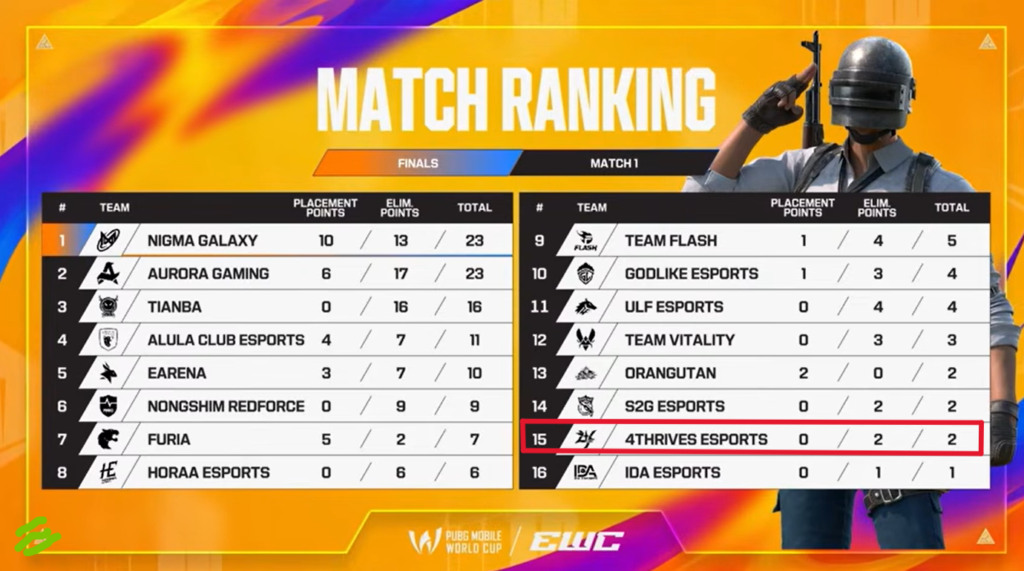
In the opening match of the finals, the hype quickly fizzled out as 4Thrives slipped near the bottom of the 16‑team table — stuck at 15th place with only 2 points to their name.
image courtesy: PUBG Mobile YouTube page
Soon, they regained their trademark confidence and began racking up eliminations against major squads. But what was truly surprising was seeing teams like Alula Gaming, FURIA, and Flash rise from the lower end of the standings to finish near the top. 4T’s gameplay throughout was too cautious and maybe pressurized.
At one point, I was stunned to realize they had absolutely no awareness of their surroundings — a glaring lack of strategy that was truly hard to believe; for instance, when T24 moved into a building where Nigma Galaxy’s Satan was already aiming towards him, T24 had no clue how to escape, especially since the rooftop offered no window for retreat.
Watching these rounds unfold proves that handling pressure at this elite level is an absolute nightmare. Competing face-to-face against the world’s greatest players for a global trophy creates a high-stakes pressure cooker. At this stage, game sense alone isn’t enough—mental fortitude under immense stress is what separates champions from the rest of the pack.
Disaster on Day 1: The PMWC 2026 Finals Crisis
Day 1 of the Grand Finals took an unexpected turn. What began as a tense tactical showdown quickly spiraled into chaos when a sudden food‑poisoning outbreak hit the venue. The organizers had to stop the matches after just four games instead of six, as more than 20 players — including major stars like GodLike Esports’ captain Manya, IDA’s Emre, and Tianba’s Milu — fell sick mid‑lobby. While several powerhouse rosters were affected, 4Thrives Esports stayed completely safe thanks to their decision to rely on halal‑prepared meals.
By the end of the first day, 4Thrives was stuck right in the middle of at 8th place with 25 points. This was disappointing for fans who expected the aggressive, high-kill gameplay that won them championships before. Known for taking big risks and getting lots of eliminations, the team looked unusually slow and passive. They stayed in the middle of the scoreboard all day and could not win a single match.
Compared to how great they looked in the Group Stage; this performance was a letdown. Meanwhile, a dominant eArena team easily took the #1 spot on the leaderboard, while 4T struggled to find their usual energy.
PMWC Grand Finals Day 2: 4Thrives Stuck at #7 as eArena Dominates
On Day 2 of the Grand Finals, 4Thrives Esports fought hard but ended the long 8-match day in 7th place with 77 points. Even though they played safely and stayed in the top half of the scoreboard, it was a frustrating day for their fans again.
Everyone was desperately waiting for the Pakistani team to finally win a single match and get a Winner Winner Chicken Dinner (WWCD). The pressure was even worse because rival teams like India’s GodLike Esports even managed to find their groove and win a match, while 4T stayed completely winless.
Instead of playing their usual explosive style, 4T played way too carefully on Day 2 too. Because they were so cautious, they couldn’t get the massive breakout matches they needed to climb higher. Meanwhile, Thailand’s eArena team absolutely dominated the tournament. They kept the #1 spot on the leaderboard with an incredible 112 points and two Chicken Dinners, leaving 4Thrives with a massive hill to climb on the final day.
PMWC Finals Day 3 Analysis
The final day of the PMWC 2026 Grand Finals was unforgiving for 4Thrives Esports fans. With the Smash Rule activated, every team was pushed to the edge, and the gap between 4Thrives and the required points for the trophy kept widening with each match. Their performance failed to close the distance, making the climb look increasingly out of reach.
Smash Rule Explained
A perfect real‑world example of the Smash Rule unfolded at the PUBG Mobile World Cup (PMWC) 2026 Grand Finals. By the end of Day 2, Team eArena sat on top with 112 points, setting the Smash Point threshold at 122 for Day 3. That single number completely changed the lobby’s behavior. S2G Esports, who had clawed back from 9th place earlier in the weekend, surged to 103 points and then smashed past the 122‑point mark on the final day — joined by three other rivals.
Suddenly, every eligible team had a target on its back. To win the trophy, they needed not just points but a final Chicken Dinner. That pushed the bottom 12 teams into full “grief mode,” hunting leaders to drag the finals out. The tension hit its peak in Match 18 when S2G was eliminated early, frozen at 154 points. Their fate was no longer in their hands — any Chicken Dinner by another Smash‑eligible team would have stolen the championship.
But relentless gatekeeping from the lobby stopped every contender from closing it out. With the match cap reached and no Smash‑eligible winner, S2G lifted the World Cup on total points.
Back to 4T, while the ultimate World Cup trophy eluded 4Thrives, they refused to go down quietly, turning the final matches into an unforgettable display of raw skill and mental resilience that kept millions of fans glued to their screens.
Controversy, 4Thrives Handled Beautifully
The heavy pressure of the Grand Finals was magnified tenfold by a heated off-screen controversy that transformed 4Thrives’ matchup against India’s Orangutan (OG) into a bitter grudge match. Following a tense group-stage encounter, OG’s official media page posted a controversial clip comparing their in-game battle to a real-world military operation. While Orangutan’s IGL Aaru quickly deleted the post and apologized to calm the regional backlash, 4T’s captain IQ issued a legendary warning on his livestream: “Shuru apne kiya, khatam hum karenge” (You started it, we will finish it).
That promise was fulfilled in spectacular fashion during Match 16 on Erangel. In a brilliant display of creativity, Falak used a horse mount to rapidly ambush a split Orangutan holding position. As the chaos unfolded, IQ stepped up to close the book, pulling off a lethal shotgun push to completely wipe out the Indian squad. It was a massive moment of poetic justice that proved 4Thrives possessed the mental fortitude to back up their trash-talk on the world’s biggest stage.
4T’s $161,000 Finish and Pakistan’s Esports Legacy
Walking away with a brilliant $161,000 USD prize pool, 4Thrives Esports made their mark as the only team carrying Pakistan’s hopes onto the global stage in Paris. For tens of thousands of us watching from home across the globe, every single drop, rotation, and clutch transformed this tournament into an unforgettable emotional journey.
To be honest, they didn’t need a conventional chicken dinner to capture our hearts; their raw tenacity spoke louder than any scoreboard. As Falak wisely noted in a post-match interview, with consistency comes an uncontrollable force—a reminder that when this roster locks in, they are a permanent danger to any lobby on earth.
Hats off to IQ, Falak, and the entire squad. Keep your heads high, stay persistent, and know that you’ve already inspired a whole new generation back home.
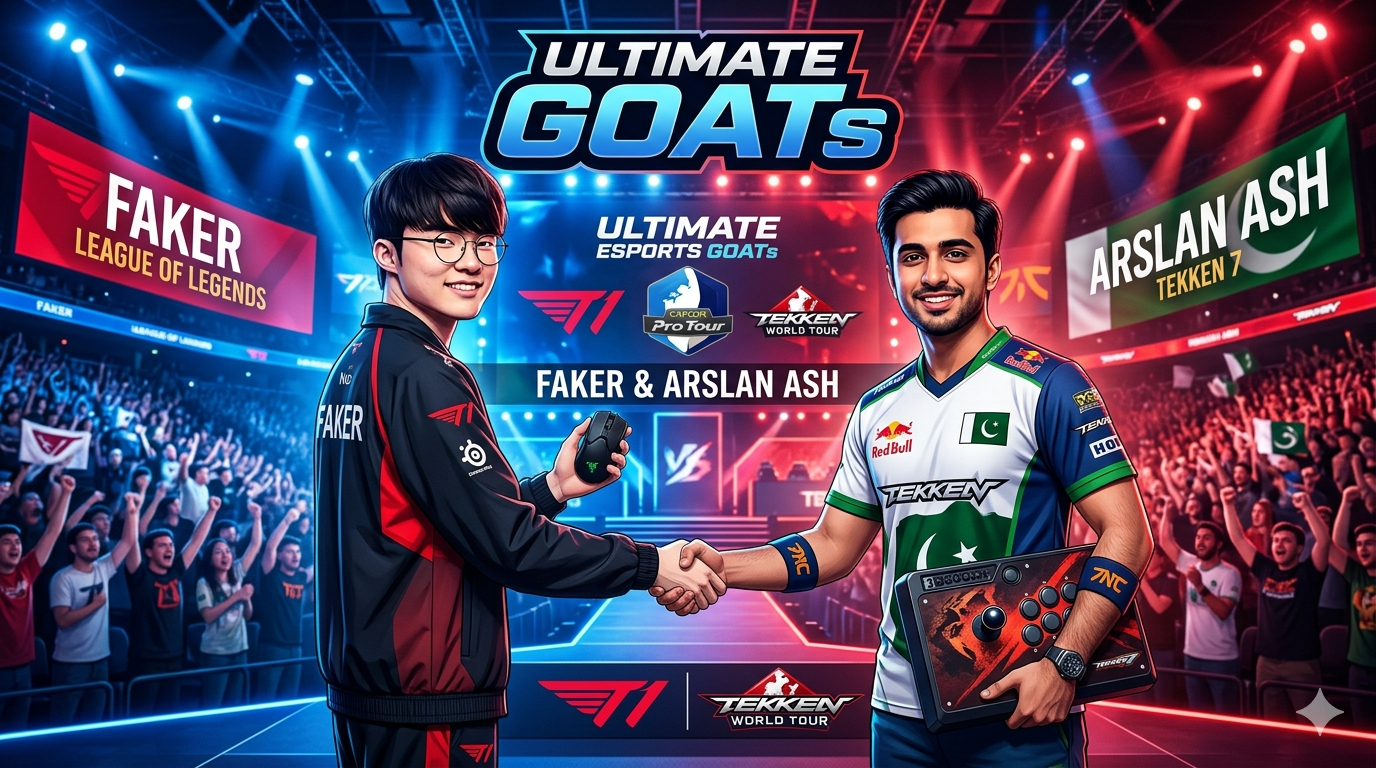
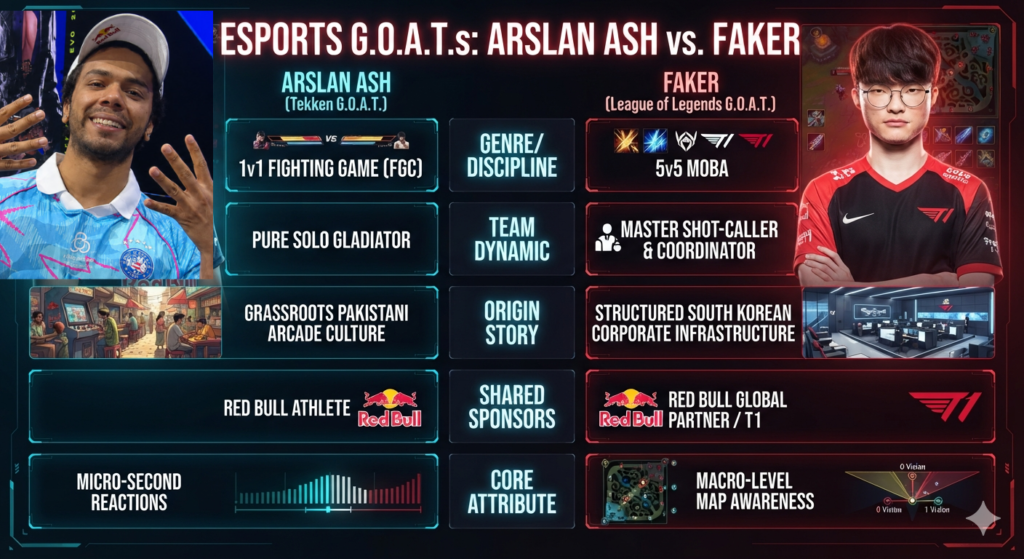
Can we compare Faker, the famous “Unkillable Demon King” of League of Legends, with Arslan Ash, the king of Tekken? At first, they seem to have nothing in common because they play completely different games. Faker leads his legendary team, T1, on the Summoner’s Rift, while Arslan Ash fights alone in intense, split-second fighting game matches. Yet, these two esports legends share a very similar story of success. Both have stayed at the top of their games for years, won the biggest trophies like Worlds and Evo, and made their home countries proud. By looking at their amazing skills and strong mindsets, we can bring these two kings into a single frame and see what makes them the ultimate rulers of competitive gaming.
Two Different Games, One Championship Mindset
To understand how these two players became legends, we have to look at their separate kingdoms. Let’s start with the player who has been ruling the PC gaming world for over a decade: Faker
The Rise of Faker: How T1’s Unkillable Demon King Dominated League of Legends
The story of the “Unkillable Demon King” began in Seoul, South Korea. Before he was famous, a teenage Lee “Faker” Sang-hyeok started playing League of Legends at home under the secret online name “GoJeonPa”. He was so incredibly good that a massive professional team called SK Telecom T1 signed him in 2013 when he was only 16 years old.
The moment he stepped onto the professional stage, his lightning-fast reflexes and genius moves shocked the world. Everyone knew a prodigy had arrived. Over his twelve-year career, Faker has grown into something much bigger than just a pro gamer. Today, he is a massive cultural hero for South Korea, standing proudly alongside K-Pop stars and famous movie actors as a symbol of Korean pride worldwide.
Faker’s Unbreakable LoL Records That May Never Be Broken
Faker competes on the Summoner’s Rift, the virtual map for League of Legends. It is a highly complex, 5v5 strategy game that is like playing high-speed chess with four teammates. In this difficult world, Faker’s achievements are unmatched:
Six-Time World Champion: Faker has led his team, T1, to a record-breaking six World Championships (in 2013, 2015, 2016, 2023, 2024, and 2025). No other player has ever come close to this level of dominance.
The Ultimate Stat Leader: He is the first player in history to score over 1,000 and then 2,000 tournament kills in the Korean professional league (LCK), while playing in more than 700 professional games.
Changing the Business of Gaming Forever
Faker did not just change how the game is played; he changed how the world looks at gaming as a real business. He is no longer just an employee—he is a part-owner of T1 Entertainment & Sports, holding a direct financial stake in a multimillion-dollar company backed by global giants such as Comcast.
Every single time Faker plays a match, millions of fans log on at the exact same time to watch him live, breaking internet viewership records over and over. Because of him, major car brands and technology giants now spend millions of dollars sponsoring esports. He has proven to the world that gaming is a real, professional sport, training like an Olympic athlete at high-tech Red Bull Performance Centers across the globe.
Faker’s Global Impact: The Ultimate Ambassador for Youth and Esports Culture
Faker’s influence stretches far beyond the Rift. Named the official Game Ambassador for the Esports World Cup and Nations Cup through 2028, he stands alongside icons like Cristiano Ronaldo and Magnus Carlsen, giving esports players a global voice.
At home, the Korean National Police Agency honored him as a Senior Officer, entrusting him to lead campaigns against youth cyber‑gambling. With the same discipline that made him a champion, Faker now guides the next generation toward healthier, brighter choices — proving that true greatness is measured not only in victories, but in the lives you inspire.
Who is Arslan Ash? The Pakistani Prodigy Who Became the Tekken GOAT
Just as Faker shapes the future from the Summoner’s Rift, Arslan Ash commands the same legendary respect from the fighting game grid. While Faker commands a five-man army, Arslan fights in complete isolation, where a single frame or a split-second miscalculation means the difference between a trophy and elimination.
The History of a Solo Phenomenon
Hailing from Lahore, Pakistan, Arslan Ash’s rise is a true grassroots story. Long before international sponsorships and streaming deals, his journey began at just eight years old in the dimly lit arcades of Lahore, mastering Tekken 4. Though initially set on a traditional path toward medicine, he chose to follow his passion for gaming — a decision met with skepticism at home. Arslan silenced doubts by dominating Pakistan’s local circuits, proving his skill was unmatched. In 2018, with modest financial help from friends, he traveled to Oman for his first international tournament. That leap of faith marked the turning point, launching him from local champion to a name recognized across the global fighting game community.
Arslan Ash’s Unbreakable EVO Records: The Highest Ceiling in Fighting Games
Arslan Ash has carved his legend in the unforgiving world of Tekken, a 1v1 fighting game where every frame and reaction can decide victory. His dominance is unmatched, reflected in a trophy cabinet that has redefined the fighting game scene.
The 8-Time EVO King: Arslan is an unprecedented eight-time Evolution Championship Series (EVO) champion. He shocked the world in 2019 by becoming the first unified champion to win both EVO Japan and EVO USA in the same calendar year.
The 2026 Milestone: Solidifying his legacy, Arslan captured his historic eighth EVO title in Las Vegas, routing a massive 1,355-player bracket to tie all-time fighting game records. He followed this up with an elite top-4 finish at the Esports World Cup (EWC) 2026 in Riyadh.
The Arslan Ash Revolution: Turning South Asia Into a Global Esports Powerhouse
Arslan Ash did not just win titles; he single-handedly put Pakistan on the international esports map. Before his 2019 breakout, the global fighting game community largely ignored South Asian talent. By defeating established international legends, Arslan forced global organizations to recognize Pakistan as a premier hub for fighting games. Today, representing the premium esports organization Twisted Minds and backed as a global Red Bull Athlete, he has opened the doors for a new generation of Pakistani pro-gamers to secure international visas, sponsorships, and careers.
For anyone unfamiliar with Pakistan’s esports scene, one truth stands out: no Tekken player from the country can claim success without Arslan Ash paving the way first. He was the first drop of rain that broke through the drought of doubt, opening doors to respectful esports careers for Pakistani players. Before him, arcade gamers were often dismissed as loafers or wanderers — young men “wasting time” in unhealthy games with no future. Arslan shattered that mindset.
By rising to the very top of global competition, he proved that discipline, resilience, and iron nerves could turn a passion into a profession. Unlike Faker, who never faced such cultural disdain in Korea, Arslan had to fight not only his opponents but also the stigma of his own society. His victories are more than trophies; they are proof that esports can be a path of pride and possibility for Pakistan.
Fun Facts: What Makes Arslan & Faker Similar
One Continent, Two Legends: Both hail from Asia — Arslan from Pakistan and Faker from South Korea — proving the continent is home to esports greatness.
GOAT Status: Whether in Tekken or League of Legends, both are celebrated as the Greatest of All Time in their respective titles.
Age of Excellence: Each is 30 years old, yet still competing at the very top of their games.
Esports Icons: They’ve turned gaming into global careers, inspiring millions and reshaping how the world views competitive play.