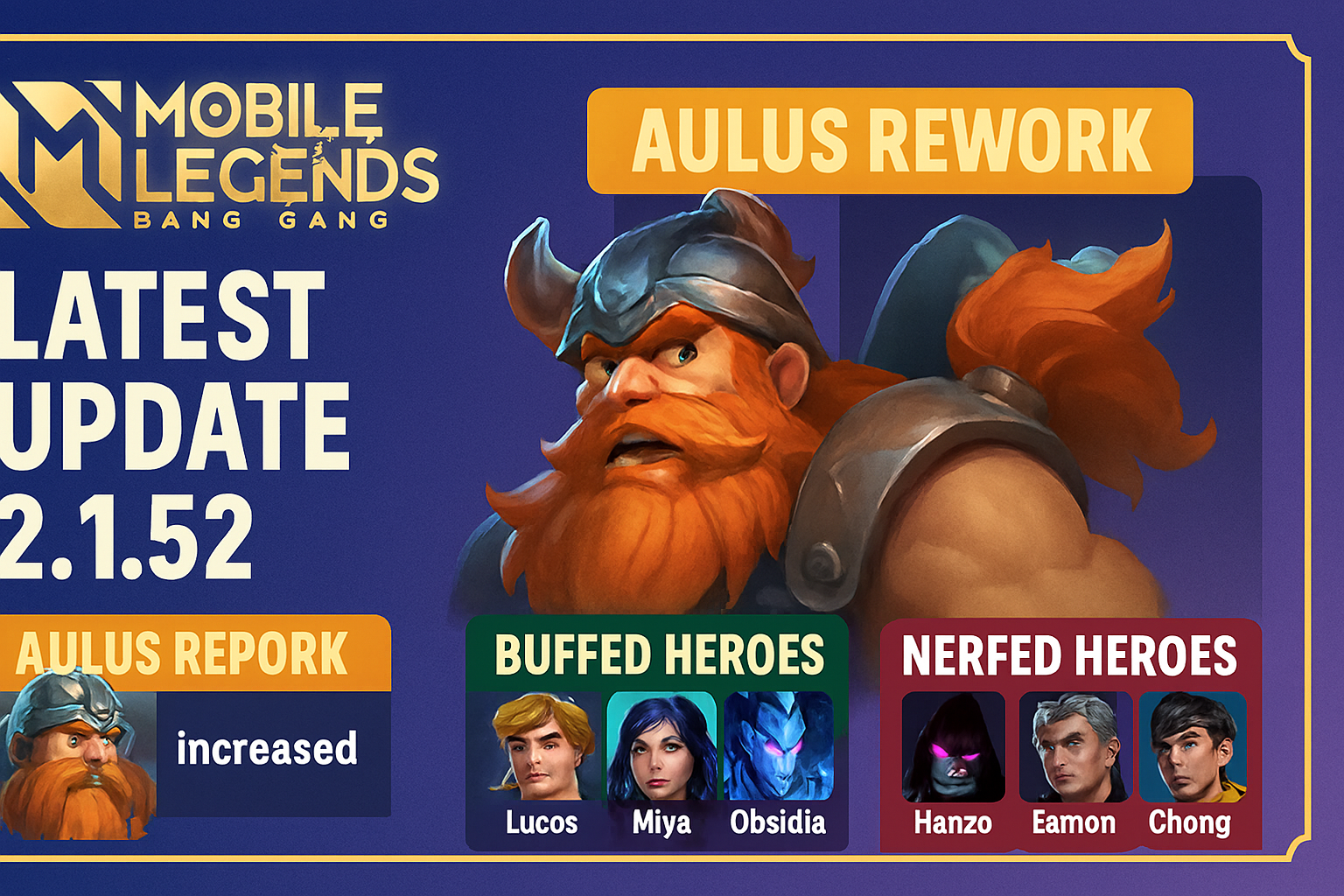
Mobile Legends: Bang Bang’s latest patch 2.1.52 brings a mix of hero reworks, buffs, and nerfs, most notably a full revamp for Aulus. The update aims to balance gameplay by strengthening underused heroes and toning down those who dominate too easily.
Key Highlights of Patch 2.1.52
Aulus Rework: The fighter hero Aulus has been completely redesigned to make him more impactful across all stages of the game. His kit now feels smoother, giving players more flexibility in fights.
Buffed Heroes:
Lucas: Gains more durability and damage, making him a stronger frontline fighter.
Miya: Improved attack scaling, helping her shine as a marksman in mid-to-late game.
Obsidia: Adjusted abilities to make her more reliable in team fights.
Nerfed Heroes:
Hanzo: Reduced damage output to limit his overwhelming burst potential.
Eamon: Adjusted stealth mechanics and damage to make him less oppressive.
Chong: Slightly weakened to balance his dominance in certain matchups.
Why This Update Matters
Better Balance: By boosting heroes like Miya and Lucas, the patch encourages more diverse picks in ranked and competitive play.
Fairer Matches: Nerfs to Hanzo and Eamon reduce frustration for players who often struggle against their high burst damage.
Fresh Gameplay: Aulus’s rework means players can rediscover him with a new playstyle, potentially shaking up the meta.
What Players Can Expect
More Variety in Drafts: Expect to see Miya and Lucas picked more often, while Hanzo and Eamon may appear less frequently.
Strategic Adjustments: Teams will need to rethink their strategies around Aulus, as his new abilities could change how fights are initiated and sustained.
Community Excitement: Updates like these usually spark experimentation, so the next few weeks will likely be filled with creative builds and new tactics.
Quick Takeaway
To be precise, Patch 2.1.52 is all about fine-tuning the balance of Mobile Legends. With Aulus’s rework and targeted buffs/nerfs, the game feels more open to different strategies, giving both casual and competitive players fresh opportunities to explore.
Prize pools worth millions have transformed three mobile titles—PUBG Mobile, Mobile Legends: Bang Bang, and Honor of Kings—from simple time-pass games into global esports giants. What began as casual matches on tiny screens has evolved into roaring stadiums, record-breaking tournaments, and players rising to international stardom.
These games didn’t just grow—they shattered expectations. Their tournaments—PMGC, MSC, and KWC—proved that mobile esports aren’t just real… they’re revolutionary.
If you are interested to know then dive deep with us!
Back Story
Around 2016–2018, the mainstream esports world was dominated by PC and console titles like CS: GO, Dota 2, League of Legends, and Call of Duty. Mobile games were often seen as casual distractions, not serious competitive platforms. Even within gaming communities, mobile players were sometimes mocked as “not real gamers.”
Here’s what that dismissal looked like:
Esports gatekeeping: Many tournament organizers and sponsors focused only on PC/console titles, assuming mobile games lacked depth or skill.
Tech limitations: Earlier mobile devices couldn’t support high-performance gaming, so mobile esports were seen as low-tier.
Regional bias: Western markets didn’t embrace mobile esports early on, while Asia and Latin America quietly built massive player bases.
Community skepticism: Forums and Reddit threads often questioned whether mobile games could ever be “legit esports.”
But then came the turning point—massive downloads, high-skill gameplay, and millions of viewers. PUBG Mobile, Mobile Legends, and Honor of Kings flipped the narrative. Their tournaments proved that mobile esports could be just as intense, strategic, and culturally powerful as any PC title.
Let me tell you how these three mobile gaming spectacles—PUBG Mobile’s World Championships, Mobile Legends’ Southeast Asia Cup (MSC), and Honor of Kings’ World Champion Cup (KWC)—grew from humble beginnings into events with jaw-dropping prize pools, mass appeal, and real‐world fame.
PUBG Mobile World Championships
In early 2019, PUBG Mobile quietly rolled out its first global tournaments. Back then, a few passionate pro teams battled for bragging rights and a modest six-figure purse. But underneath the scenes, PUBG’s maker, Krafton, spotted a gold mine: more than a billion downloads, millions playing every day, and live streams drawing tens of thousands.
By the 2021 Global Championship, Krafton teamed up with giant sponsors—car makers, energy drinks, tech brands—injecting a record $6 million into the prize pool. Suddenly, professional PUBG Mobile players were earning more than many PC esports pros. Viewers swelled into the tens of millions, and major sports channels in South Korea and India even ran highlight reels on TV. When the dust settled, PUBG Mobile had cemented itself as the biggest mobile-only esport on earth.
Mobile Legends: Southeast Asia Cup (MSC)
Back in 2017, Mobile Legends: Bang Bang was just one of many mobile MOBA experiments. But in Southeast Asia—Malaysia, Indonesia, the Philippines—the game exploded. Fans packed internet cafés and stadiums alike to cheer on local heroes. Seeing this passion, developer Moonton launched the MSC in 2018 with a $100,000 prize pool.
Year after year, the MSC prize grew—half a million, then three-quarters, then crossing the $1 million mark by 2023. Why? Because Southeast Asia’s mobile-gaming community rallied behind it: celebrities streamed it on social media, Telco companies sponsored local qualifiers, and government sports bodies even included it in national e-games festivals. Today MSC finals fill 10,000-seat arenas, trend on Twitter region-wide, and have turned school-yard prodigies into social media stars overnight.
Honor of Kings: World Champion Cup (KWC)
Right next door in China, Tencent’s Honor of Kings quietly set daily active user records that rival Facebook. In 2019, its first international showdown—the World Champion Cup (KWC)—offered a prize pool of ¥10 million (around $1.5 million USD). But that was just the beginning. By 2022, the newly branded International Championship raised the stakes to a staggering $10 million USD, making it the richest mobile esports tournament in history. With viewership soaring across platforms like Bilibili and Douyin, Honor of Kings proved it wasn’t just a game—it was a national spectacle.
Why so rich?Honor of Kings was more than a game—it became a cultural icon. University esports leagues embraced its logo, and Chinese sports commissions granted pro players athletic status for international travel. The KWC finale streamed across platforms like Bilibili, Douyin, and national TV, with viewership estimates soaring past 100 million. Winning the KWC is now seen as a national achievement—celebrated with the same pride as Olympic gold in parts of China.
Why Such Massive Prize Pools?
Massive Player Bases: Each title boasts hundreds of millions of installs and millions of daily users.
Developer Investment: Tencent and Krafton treat these games like national sports, pouring in sponsor deals and broadcast rights.
Regional Passion: In China and Southeast Asia, mobile gaming is mainstream leisure—local celebs, telcos, even schools jump on board.
Media & Sponsors: From car makers and beverage brands to national TV networks, everyone wants a piece of the explosive mobile-esports boom.
These factors combined to turn once-small contests into multimillion-dollar spectacles. And with every new season, more eyes tune in, more brands buy in, and the winner’s circle becomes even sweeter—proof that mobile esports have truly gone global.
What’s next?
Beyond prize money, these series are carving paths to stadium shows, franchised leagues, and even talks with traditional sports bodies. Soon, we’ll see mobile-esports athletes honored alongside cricket legends and football stars—another sign that the mobile revolution is just beginning.